Exploring the Framework for a Balanced Development Model
Throughout history, humanity has evolved from early civilizations, where communities lived in closer harmony with nature, to increasingly complex societies shaped by technological innovation and economic development. Early communities relied on sustainable practices, cooperation, and social cohesion, maintaining a delicate balance between human activity and the natural environment. The Industrial Revolution marked a turning point, accelerating scientific progress and economic growth, but often at the expense of social equity and ecological sustainability. This imbalance has contributed to resource exploitation, growing inequalities, and global challenges such as climate change and wasteful consumption. The Balanced Development Model offers a 21st-century framework to enhance harmony across the social, economic, and ecological dimensions of the development process, based on a foundation of balance between the spiritual and material components of life. By promoting empowerment, innovation, and conservation, it provides a pragmatic pathway toward a more united, equitable, and regenerative world, contributing to the advancement of civilization.
Ancient Civilizations
Ancient civilizations emerged where people first formed large, organized societies, laying the foundations of the world we know today. In Mesopotamia, civilizations such as Sumer, Babylon, and Assyria pioneered advances in law, astronomy, mathematics, and writing, shaping early scientific and legal thought. Along the Nile River, Egyptian civilization developed monumental architecture, engineering, medicine, and rich spiritual traditions. In Persia, the Achaemenid Empire, established by Cyrus the Great over 2,500 years ago, became one of the largest and most influential empires of the ancient world, renowned for its advanced administration, cultural and religious tolerance, and principles of humane governance. In East Asia, Chinese civilization, shaped through the Xia, Shang, and Zhou dynasties, established enduring systems of philosophy, ethics, governance, and technology. In the Americas, civilizations such as the Olmec, Maya, and Inca advanced astronomy, agriculture, architecture, and calendrical science. Together, these civilizations contributed to humanity's shared heritage and continue to inspire today's interconnected global society.


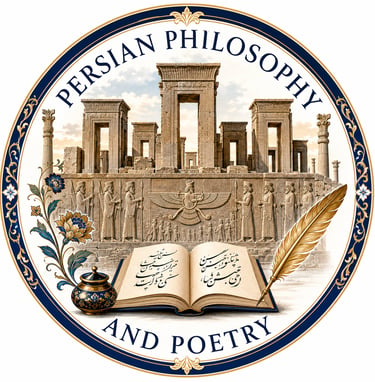
Persian Philosophy and Poetry
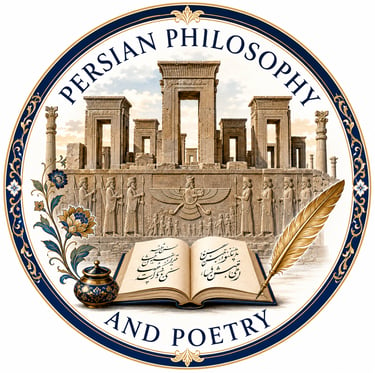
Persian civilization has made profound contributions to humanity's intellectual, cultural, and ethical heritage. Ancient Persian philosophy, rooted in the teachings of Zarathustra, emphasized truth, justice, wisdom, and moral responsibility as essential foundations of a flourishing society. Central to this tradition was the principle of "good thoughts, good words, and good deeds," encouraging individuals to cultivate virtue and contribute to the well-being of their communities. The Cyrus Cylinder, often regarded as the world's first charter of human rights, proclaimed freedom of belief, protection of communities, and humane governance, reflecting Persia's early commitment to human dignity and social justice. These philosophical ideals found enduring expression in Persian poetry. Renowned poets such as Ferdowsi, Saadi, Hafez, and Rumi explored themes of love, compassion, unity, justice, and the search for meaning. Their works served not only as literary masterpieces but also as guides for ethical living and personal transformation. Together, Persian philosophy and poetry offer a timeless vision that integrates knowledge and wisdom, individual growth and social responsibility, and material progress and spiritual growth, contributing to the evolution of civilization.
“论语” The Analects of Confucius
The Analects of Confucius (论语, Lúnyǔ) serves as a profound framework for personal growth and community development through its teachings on virtues (德, dé), moral conduct (道德行为, dàodé xíngwéi), reflection (反思, fǎnsī), and practice (实践, shíjiàn). At its core, the Analects emphasizes the cultivation of virtues such as kindness (仁, rén), integrity (义, yì), wisdom (智, zhì), propriety (礼, lǐ), and respect (敬, jìng) as essential qualities for becoming a virtuous person (君子, jūnzǐ). This framework guides individuals through a disciplined process of self-cultivation (修身, xiūshēn), urging continuous learning (学习, xuéxí), deep reflection (反思, fǎnsī), and consistent practice (实践, shíjiàn) of ethical principles to embody these virtues fully. Extending to community life, it advocates for harmonious relationships (和谐关系, héxié guānxi), social harmony (社会和谐, shèhuì héxié), and ethical interactions (伦理互动, lúnlǐ hùdòng) that foster a balanced and cooperative society. By translating these passages of the Analects and utilizing artificial intelligence for in-depth analysis, we aim to contribute to the global community, offering a framework for a more harmonious, equitable, and sustainable world.
Please join us online at the following link, where we share our research on 论语 the Analects of Confucius


Foundations of Classical Western Philosophy
For over two millennia, the wisdom of Socrates, Plato, and Aristotle has shaped philosophy, education, and the human search for truth. Each offered a distinct yet harmonious path—Socrates through inquiry, Plato through imagination, and Aristotle through observation—together forming the core of classical Western philosophy. Socrates taught through questions, guiding others to examine their lives, challenge assumptions, and seek truth within. His Socratic Method revealed that wisdom begins with humility and that education should awaken the soul, not simply transmit information. Plato, his devoted student, envisioned a world guided by justice, virtue, and the power of ideals. In The Republic, he described reality as both visible and eternal—a journey from shadows to light, where education becomes the art of turning toward truth. Aristotle, in turn, grounded knowledge in reason, experience, and purposeful action. In works such as Nicomachean Ethics, he taught that human flourishing arises from practicing virtue, cultivating balance, and uniting thought and action in daily life. Together, their insights form a living legacy, reminding us that true progress depends not only on knowledge but on the cultivation of character, and that a balanced civilization must integrate mind, heart, and purposeful action. 🌏

The Age of Enlightenment
The Age of Enlightenment — also known as the Age of Reason — was a powerful movement in the 17th and 18th centuries that transformed the world’s way of thinking. ✨ It encouraged people to question old traditions and to use reason, science, and moral philosophy to improve society. Thinkers like John Locke (England) promoted natural rights — life, liberty, and property — and believed governments should protect these rights. 🕊️ Voltaire (France) spoke boldly for freedom of speech and religion, challenging intolerance and injustice. Jean-Jacques Rousseau emphasized democracy and the idea that true authority comes from the will of the people. Montesquieu introduced the separation of powers — the basis of modern democracy. ⚖️ In Germany, Immanuel Kant urged people to “dare to think for yourself,” inspiring moral independence and human dignity. The Enlightenment gave rise to revolutions, new sciences, and human rights — laying the foundation for modern civilization and inspiring future generations to seek truth through knowledge, virtue, and freedom. 🌍💡
The American Experience: A Journey of Collective Vision
The United States of America stands as a remarkable story of a nation shaped not only by geography, but by ideas, vision, and a bold collective initiative. From its humble beginnings in the late 18th century, thirteen diverse colonies united in pursuit of freedom, self-governance, and human dignity, laying the foundation for a new kind of society. Influential founders such as George Washington, Thomas Jefferson, and Benjamin Franklin, articulated these aspirations through the Declaration of Independence (1776) 📜, affirming that “all men are created equal.” ✨From its earliest days, the nation has reflected an evolving democratic experience, balancing individual liberty with collective responsibility, while also facing profound challenges—including slavery, inequality, civil rights and social justice. Over time, the American experience has been shaped by immigrants from around the world pursuing the American Dream, contributing to remarkable achievements in innovation, economic growth, science, and space exploration. 🌎 As a living and dynamic process, America continues to evolve through reflection and resilience, guided by an enduring commitment to freedom, the pursuit of success, and the aspiration toward a brighter future for all.


The Bahá’í Writings: A Vision of World Unity
Our research, programs and outreach are inspired by the Bahá’í vision of world unity—a vision founded on the principle of the oneness of humanity, inspiring the global community to collectively "carry forward an ever-advancing civilization." The Bahá’í Writings envisions a future in which unity in diversity, justice, and collaboration become the foundations of a peaceful and prosperous global society. This vision emphasizes the harmonious advancement of spiritual and material civilization, recognizing that ethical values, scientific progress, education, and innovation must evolve together. It also highlights the importance of consultation, collective decision-making, and effective administration as essential elements of good governance and sustainable progress. The Bahá’í approach to social and economic development encourages communities to build local capacity, promote education, foster service, strengthen families and institutions, encourage entrepreneurship and innovation, and create systems that advance both individual well-being and the common good. Central to this vision is the empowerment of individuals, communities, and institutions as the protagonists for change, each playing a complementary role in advancing civilization through learning, collaboration, and service.
Please join us online at the following link, where we share our research on the Bahá’í Writings
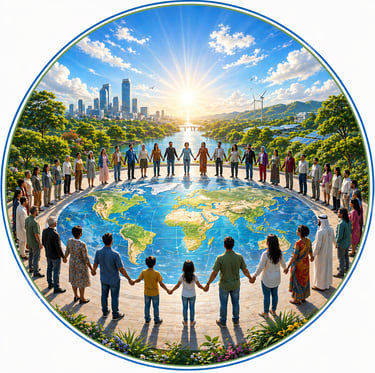

Community Empowerment and Future Civilizations
At the heart of community empowerment is Higher Intelligence, the spiritual expression of the human being that connects us to our higher nature—our capacity for meaning, conscience, creativity, and moral purpose. Inspired by spiritual teachings and cultivated in peaceful, loving, and inclusive environments, Higher Intelligence brings forth the best within each person and is strengthened through service to humanity, where inner purpose becomes collective action. From this foundation emerges Spiritual Enterprise, a development model that empowers communities by nurturing human potential (spirit, mind, and body) while responsibly cultivating natural resources. It integrates the social, economic, and ecological dimensions of development, ensuring that progress serves both people and the planet. Guided by higher intelligence and spiritual enterprise, communities are empowered to innovate toward a more united, equitable, and regenerative world. Through this integrated pathway, community initiatives become the engine for change and the advancement of future civilizations. Watch our video series on the character of “Future Civilizations,” based on the Balanced Development Model, at the following links:
Future Civilizations: explores possible future scenarios and innovations toward a more united, equitable, and regenerative world.
Future of Empowerment and Education: envisions how education could evolve to empower the whole person through character, lifelong learning, creativity, innovation, AI mentorship, community participation, and service.


Innovation for a more United, Equitable, and Regenerative world.
© 2026 Center for Balanced Development. All rights reserved.